
How to Find Recently Released Albany County Inmates
Albany County does not publish a separate recently released inmate list in the official sources reviewed. Release can follow many paths. A person may be released after posting bail, after a recognizance or non-monetary order, after charges are disposed, when a sentence expires, on transfer, or when a hold is resolved. Each path produces a different record trail.
The reliable sources are direct. Call the Albany County Correctional Facility through the Sheriff's corrections page, check VINELink for custody and release status, look at WebCrims for release-related court appearances, and use DOCCS or BOP only when the person was in state or federal custody. A person released by a judge's order may still take hours to walk out, because paperwork, warrant checks, property return, and payment confirmation must clear first.
That delay surprises families. A release announced in a courtroom at 16 Eagle Street is not the same as a release completed at 840 Albany Shaker Road. Confirm the actual discharge with the jail rather than assuming the courtroom statement is the final word.
Setting Up Albany County Release Notifications
VINELink is the free notification service that tells a registered user when a custody or release status changes, if the holding facility participates. It is the closest thing to an automated release alert that an Albany County family can use.
- Open VINELink and select New York as the state.
- Narrow to the Albany County facility if it is listed.
- Search by offender ID or by name.
- Enter a phone number or email for alerts.
- Confirm the registration so notifications can be delivered.
VINELink is a notification tool, not a full court-record database. It tells a user about a status change. It does not give the case outcome, the sentence, or the underlying charge history. For those, use the court portals on the court records page.
Searching State and Federal Released Inmates
When a person served a state prison term, the New York Department of Corrections and Community Supervision is the source. The DOCCS incarcerated lookup can show custody status, facility, admission data, and parole eligibility or release dates where public. DOCCS also covers community supervision after release.
Federal release data is separate. The Bureau of Prisons inmate locator shows federal register numbers, age, release status, and facility. A county jail detainee will not show up in either system unless they were sentenced to state or federal custody. The field table below lists the identifiers each locator accepts.
| Locator | Best Identifier | Name Search |
|---|---|---|
| NY DOCCS | DIN or NYSID | Last and first name with birth year. |
| Federal BOP | Register number | Last and first name with age, race, or sex filters. |
DOCCS does not show county jail booking photos or local housing units. BOP does not show state or county custody. Match the system to the sentence before searching.
Verifying a Release in Person or by Phone
For a county jail release, the fastest confirmation is a call to the facility. The corrections page lists the contact route. A caller should have the full legal name, an approximate date of birth, and any case or booking number ready. Staff can confirm whether the person is still in custody or has been discharged, within the limits of what they are allowed to disclose.
Albany County Correctional Facility
840 Albany Shaker Road
Albany, NY 12211
Albany County Sheriff's Office
albanycountyny.gov/government/county-sheriff/corrections
A release on one case does not always mean freedom. A hold, a warrant, a parole or probation matter, an immigration detainer, or an out-of-county case can keep a person in custody after bail clears on the first matter. The warrant records page covers how those holds work.
The New York Sex Offender Registry
The New York Division of Criminal Justice Services runs the public sex offender registry under Correction Law Article 6-C. The registry is a separate system from any release list. It shows registrants by risk level, with the data the law allows for public display.
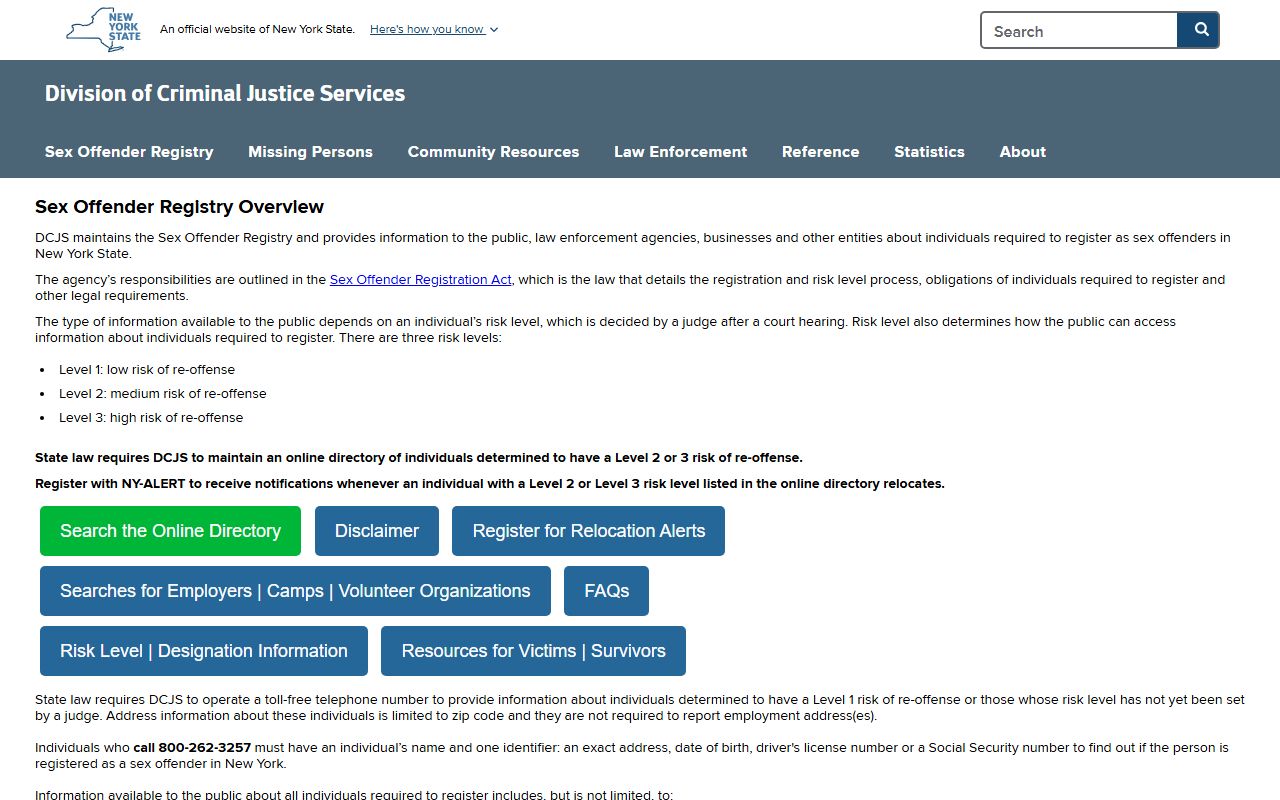
The DCJS registry search accepts a last name, first name, county, and ZIP or address radius where offered. Results may show name, aliases, a photograph where available, risk level, address status as permitted by law, and offense information. The registry framework comes from Correction Law § 168-b. Registry data is not a complete criminal-history report and should not be used to infer current custody or warrant status.
Parole and Community Supervision
A person released from a New York state prison term is often placed on community supervision. DOCCS runs that supervision and publishes information at the community supervision page. Parole conditions can include reporting requirements, curfews, treatment, employment expectations, and travel limits.
County-level probation is different from state parole. Probation is court-ordered supervision in the community, often imposed instead of or alongside a jail sentence. Parole follows state-prison release. Both can produce a violation warrant if conditions are broken, which is why a person under supervision who misses a requirement should call their officer or counsel quickly rather than wait.
Reentry Resources in Albany County
Release is the start of a long list of practical tasks. Identification, benefits, housing, employment, and behavioral-health support all matter in the first weeks. The Capital Region has resources that serve people leaving custody, and the list below is a starting point rather than a complete directory.
- DOCCS community supervision for parole reporting and conditions.
- Legal Aid Society of Northeastern New York for civil legal problems tied to reentry.
- SNAP and benefits offices for food and income support eligibility.
- Workforce and job-placement services in the Capital District.
- Behavioral-health and substance-use providers for ongoing treatment.
The Albany County Public Defender can help with criminal matters that follow a person after release. For self-help on civil issues like housing and family court, the New York Courts CourtHelp portal is the central statewide resource.
What Albany County Release Records Show
A release record is a custody event, not a case outcome. It tells a user that a person left a facility on a date. It does not by itself explain why. A person can be released because charges were dismissed, because a sentence ended, because bail was posted, or because the case moved to another court. Reading too much into a bare release entry is a common mistake.
For the full picture, three records have to be read together: the custody record from the jail or locator, the court disposition from the case file, and, for supervised people, the parole or probation status. Each lives in a different system. The custody record comes from the facility or VINELink, the disposition comes from the court, and supervision status comes from DOCCS or county probation.
| Record | What It Answers | Where to Get It |
|---|---|---|
| Custody / release status | Is the person in custody or released, and when. | Jail, VINELink, DOCCS, or BOP. |
| Case disposition | How the underlying case ended. | Court file or certified disposition. |
| Supervision status | Whether parole or probation applies after release. | DOCCS community supervision or county probation. |
Employers and landlords sometimes treat a release date as if it were a conviction record. It is not. A certified disposition from the court is the document that answers conviction questions, and the court records page explains how to request one.
Civil Rights Restoration After Release
New York restores voting rights after incarceration for a felony. A person on parole or community supervision may vote if otherwise eligible under current New York election law. That is a meaningful change for many people leaving custody, and it is worth confirming with current state election guidance before an election.
Voting and firearm rights are separate. Voting rights are restored after incarceration in New York. Firearm rights are a different question and can remain restricted after a felony conviction. Treat them as two distinct issues, not one.
Sealing is another post-release path. Some convictions become eligible for sealing under New York law after waiting periods. The arrest records page covers the sealing statutes in more detail, including the application-based sealing route.
Note: Release records and reentry rules change with state law, so confirm current voting, sealing, and supervision rules with official New York sources before acting.
Why Release Timing Varies in Albany County
Families often expect a release to happen the moment a judge says the word. It rarely works that way. A release order is a starting point, not a finish line. The jail must receive valid court or agency paperwork before it can discharge anyone, and several checks run before the door opens.
- Paperwork from the court must reach the facility and be processed.
- Bail or bond payment must be confirmed when the release depends on it.
- Staff must run warrant and detainer checks for other holds.
- Stored property and money must be returned to the person.
- Discharge processing and transport, if needed, must be arranged.
Bond posting follows the Albany County corrections bail page, which lists current payment methods and hours. New York bail can take several forms, and the court order controls which form applies. Keep every receipt, and confirm the actual discharge with the jail rather than relying on the courtroom announcement alone.
Does Albany County post a public list of released inmates?
No separate recently released list was confirmed in the official sources reviewed. Verify a release through the jail, VINELink, the court, or counsel. For state or federal release data, use the DOCCS lookup or the BOP locator described above.