
How to Look Up Albany County Jail Population Data
Albany County jail population data does not sit in one daily dashboard in the official sources reviewed. The figures come from several places, and each updates on its own schedule. A researcher should treat the population question as a layered one and read the local source against the broader context sources.
The most authoritative local figures come from the Albany County Sheriff's Office, county budget documents, and New York State Commission of Correction reporting. Those sources carry rated capacity and population numbers when published. For trend and comparison, the federal Bureau of Justice Statistics and the Prison Policy Initiative New York profile add state and national framing. None of those context sources should be quoted as the county's official daily count.
This page does not run a population search box. It explains where the data lives and how to read it. For an individual custody question, the inmate records page is the right starting point, because population data and name lookups are separate tasks.
Albany County Jail Capacity Overview
Capacity and population are different numbers, and confusing them is the most common error in jail-data reading. Rated capacity is the facility's approved housing limit. Population is the number of people actually held on a given day or averaged over a period. A jail can run below, at, or near capacity, and the relationship changes constantly.
| Facility | Rated Capacity | Average Daily Population | Source Status |
|---|---|---|---|
| Albany County Correctional Facility | Not confirmed in official sources reviewed | Not confirmed in official sources reviewed | Use Sheriff annual report, county budget, or NY Commission of Correction data. |
The official county pages confirmed the facility's identity at 840 Albany Shaker Road but did not publish a current rated capacity or daily population during the research pass. A researcher who needs an exact current figure should request the Sheriff's annual report or a county budget line, or file a public records request as described on the public records page.
Average Daily Population in Albany County
Average daily population, often shortened to ADP, is the standard way jails report how full they are over time. It smooths out the daily swings caused by weekend arrests, court calendars, and release timing. A single-day count can mislead. ADP over a month or a year is the more honest measure of how heavily a facility is used.
ADP rises and falls with forces that have little to do with crime rates alone. Bail decisions, court backlogs, the speed of case disposition, and transfer timing all move the number. New York's bail changes in recent years affected pretrial detention statewide, though the county-specific effect should be confirmed with Albany County data rather than assumed from a statewide pattern.
Demographic Breakdown
Demographic breakdowns of a jail population should come from official reports. The county pages reviewed did not publish a current demographic table for the Albany County Correctional Facility, so the honest statement is that the local breakdown was not located in official sources during the research pass.
For context, the Prison Policy Initiative publishes a New York profile that breaks down incarceration by race and other factors at the state level. Those state figures are useful for framing, but they are not a substitute for an Albany County table. Where a researcher needs the county breakdown, the Sheriff's report or a public records request is the route.
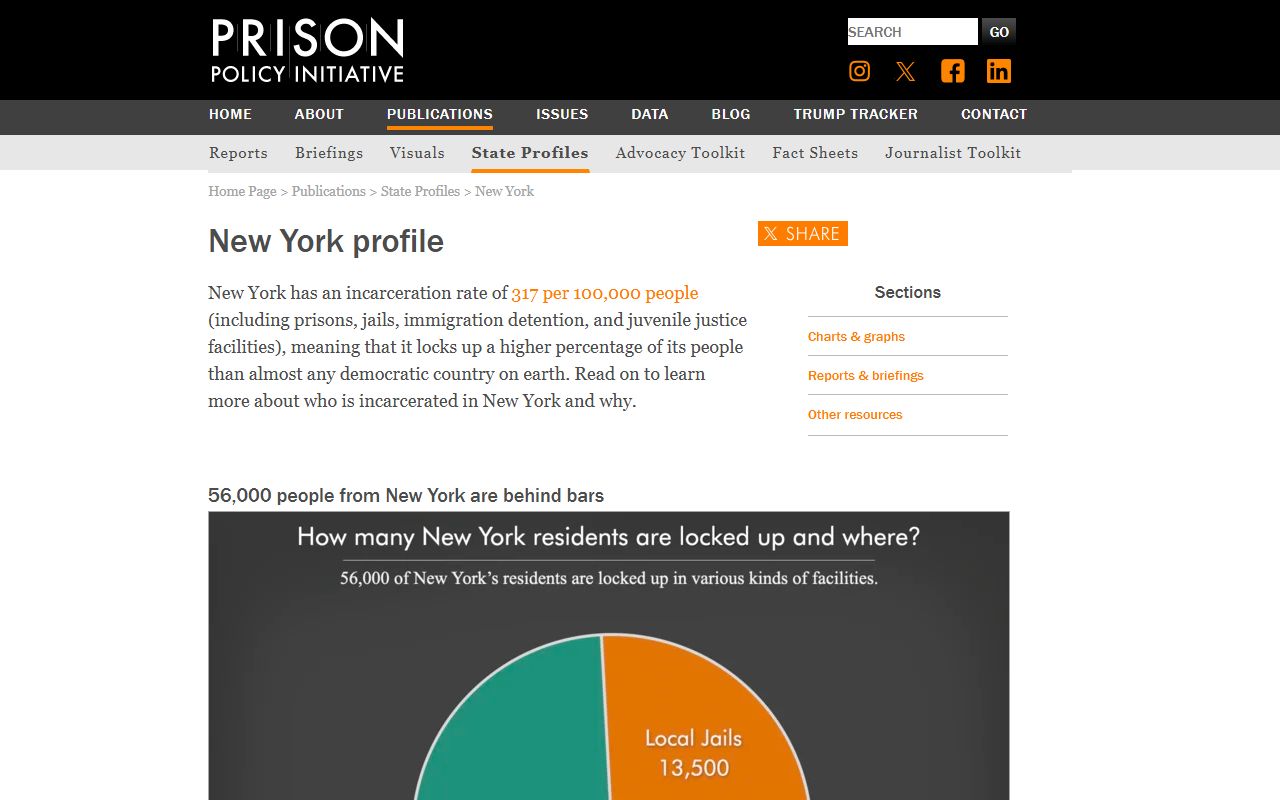
The Prison Policy Initiative profile sets New York's incarceration in national context, which helps a reader judge whether a local figure is high or low relative to the state.
Pretrial vs Sentenced Population
A county jail holds two broad groups. Pretrial detainees are people held before their cases are resolved, often because bail was set and not posted. Sentenced inmates are serving a local jail sentence after conviction. The split between the two matters because it speaks to how a jail is being used.
| Group | Who They Are | What Drives the Count |
|---|---|---|
| Pretrial detainees | Held before disposition, often on unposted bail. | Bail decisions, court speed, charge severity. |
| Sentenced inmates | Serving a local jail term after conviction. | Sentence length and local sentencing patterns. |
| Holds and transfers | Held for another agency or awaiting transfer. | Detainers, warrants, and state or federal holds. |
State prisoners are generally not in the county jail. They are tracked by DOCCS. A high pretrial share usually points to bail and case-processing factors, while a high sentenced share points to local sentencing. The exact Albany County split was not published in the official sources reviewed.
Misdemeanor vs Felony Population
Charge severity shapes the population too. Felony holds, parole violations, probation violations, warrants, and local sentences all add to the count in different ways. A misdemeanor matter is less likely to produce a long jail stay than a serious felony hold, so the mix of charges affects both the headcount and the average length of stay.
Length of stay is the hidden driver. A small number of long-stay felony holds can occupy more bed-days than a large number of short misdemeanor stays. That is why a jail can book thousands of people a year and still hold a few hundred on any given day. The Albany County charge mix should be read from county reporting rather than estimated.
Mental Health and Medical Population
Jails hold a significant share of people with behavioral-health and medical needs. Screening at intake flags many of these needs, and the facility manages treatment, medication, and supervision accordingly. This share of the population is real and consequential, but the operational detail is confidential.
Public population pages should not publish individual medical, suicide-watch, or classification data. Those details are protected. What a researcher can responsibly report is that behavioral-health demand is a documented national feature of county jails, confirmed by federal corrections research, and that Albany County manages screening and care through the facility rather than through any public dashboard.
National and State Context
The Bureau of Justice Statistics is the federal source for national jail and corrections data. Its reports set the baseline a local figure should be read against, including national jail population trends and incarceration rates per 100,000 residents.
BJS publishes the national jail figures that frame any single county's count. Read against that baseline, a researcher can judge whether Albany County sits above or below typical rates. The comparison below shows the three levels a reader should keep separate.
| Level | Source | Use |
|---|---|---|
| County | Albany County Sheriff / budget / state corrections data | The actual local count, when published. |
| State | Prison Policy Initiative New York profile | How New York compares nationally. |
| National | Bureau of Justice Statistics | The baseline rate per 100,000 residents. |
Population Trends Over Time
Jail population is best understood as a trend, not a snapshot. Year-over-year movement reveals more than any single day. Many jails saw population swings during the pandemic years, and bail-law changes shifted pretrial detention across New York. Whether Albany County followed those patterns should be confirmed with county-specific data rather than assumed.
For trend comparison, the Vera Institute publishes county incarceration trends that track admissions and population over time. The Prison Policy Initiative and BJS add the state and national lines. Together they let a researcher see whether the local trend runs with or against the broader direction. None of these context sources is the county's certified daily count.
Trends also help separate signal from noise. A one-month spike could be a court backlog or a single large case, while a multi-year rise points to something structural in arrests, bail practice, or sentencing. Albany County's role as the state capital adds a wrinkle, because the courthouse district handles a heavier mix of cases than a purely rural county. A researcher comparing Albany to a small upstate county should account for that difference rather than expecting identical numbers.
How to Read Albany County Population Numbers
Population data is easy to misread. A few habits keep a reader honest. First, always check whether a figure is a single-day count or an average. Second, check the date, because a number from three years ago may not reflect today. Third, check the source level, because a state rate and a county count are not the same thing.
- Confirm whether the figure is a snapshot or an average daily population.
- Note the reporting date and how often the source updates.
- Separate county, state, and national figures rather than blending them.
- Compare capacity to population to judge how full the facility runs.
- Treat context sources as framing, not as the county's official count.
A reader who follows those steps will avoid the two most common errors: treating a national rate as a local count, and treating one busy weekend as a permanent trend. Population data rewards patience and clear labels more than any single dramatic number.
Searching for Albany County Inmate Records by Name
This page is population data, not a name search. A person looking for one individual in custody should use the inmate records page, which covers the Sheriff's corrections contacts, VINELink notifications, and the state and federal locators. Population figures and individual custody lookups are separate tasks and use different tools.
Where Albany County Population Data Comes From
The cleanest population research keeps sources labeled. County figures come from the Sheriff, the county budget, and New York State Commission of Correction reporting. State context comes from the Prison Policy Initiative. National context comes from the Bureau of Justice Statistics. Trend data comes from the Vera Institute. A reader who keeps those labels straight will not mistake a national rate for a local count.
Note: County-specific capacity, daily population, and demographic figures were not confirmed in the official sources reviewed, so request them from the Sheriff or through a public records filing.