
How to Search Albany County Court Records
Searching court records in Albany County is not a one-portal job. New York splits records by court and by record type. A civil case may be in WebCivil Local. A criminal appearance may be in WebCrims. A probate file may be in WebSurrogate. E-filed documents may sit in NYSCEF. Recorded deeds, mortgages, and judgments live in the Albany County Clerk online records search, which routes to the IQS portal.
Before you start, gather the case caption, party names, approximate filing year, and the index, docket, or file number if you have one. The official Third Judicial District page at ww2.nycourts.gov/courts/3jd is a useful map of every Albany court.
The Third Judicial District homepage lists every court that serves Albany County, with links to the Supreme, County, Family, Surrogate, and Albany City Court pages.
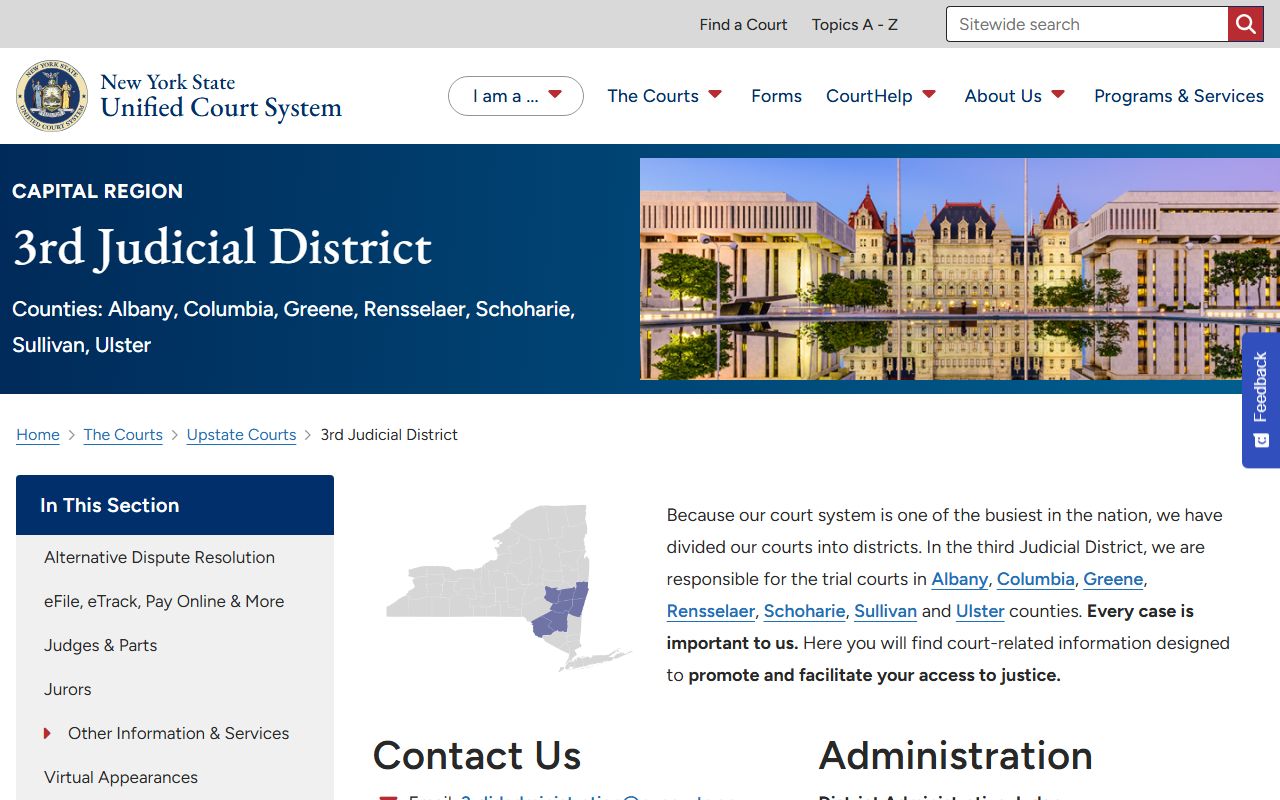
Use the district page to confirm court phone numbers and assigned justices before you call. Each portal asks for slightly different inputs, so the search itself follows a short sequence.
- Decide which court holds your case. Civil and matrimonial go to Supreme Court. Felonies go to County Court. Estates go to Surrogate's Court.
- Open the matching portal. WebCivil Local, WebCrims, WebSurrogate, NYSCEF, or the County Clerk IQS portal.
- Select Albany as the county. A statewide name search returns too much noise.
- Enter a party name or a known index, docket, or file number. Try last name only first.
- Open the docket and read the entries. Note the part, the judge, and the next appearance date.
- Ask the clerk for a certified copy if you need it for court, immigration, or licensing use.
The Albany County Judicial System
New York court names can confuse first-time searchers. The Supreme Court is the trial court of general jurisdiction. It is not the highest court. The state's top court is the Court of Appeals. Appeals from Albany trial courts go to the Appellate Division, Third Department, which sits in Albany itself.
Albany County Court hears felony criminal cases. Family Court hears custody, support, and family-offense cases. Surrogate's Court handles wills, estates, and adoptions. Albany City Court takes city-level criminal, traffic, civil, landlord-tenant, and small-claims matters. Town and village justice courts cover tickets and local cases outside the city. Each court keeps its own records.
Case flow: Town or Village Court › Albany City Court › County Court › Supreme Court › Appellate Division, Third Department
| Court | Jurisdiction | Case Types |
|---|---|---|
| Albany County Supreme Court | General civil trial court | Civil, matrimonial, Article 78, equity |
| Albany County Court | Felony criminal, some civil | Indictments, felony prosecutions |
| Albany County Family Court | Family and juvenile | Custody, support, family offense, JD/PINS |
| Albany County Surrogate's Court | Estates and probate | Wills, administration, guardianship |
| Albany City Court | Albany city limits | Traffic, misdemeanor, small claims, L&T |
| Town and Village Justice Courts | Each municipality | Tickets, arraignments, local civil |
Albany County Courthouses
Albany's court district is tight. Most state-court business runs through three downtown buildings within a few blocks of each other. The official New York Courts page for the Supreme and Surrogate's Courts at nycourts.gov confirms the courthouse address and the lead court links.
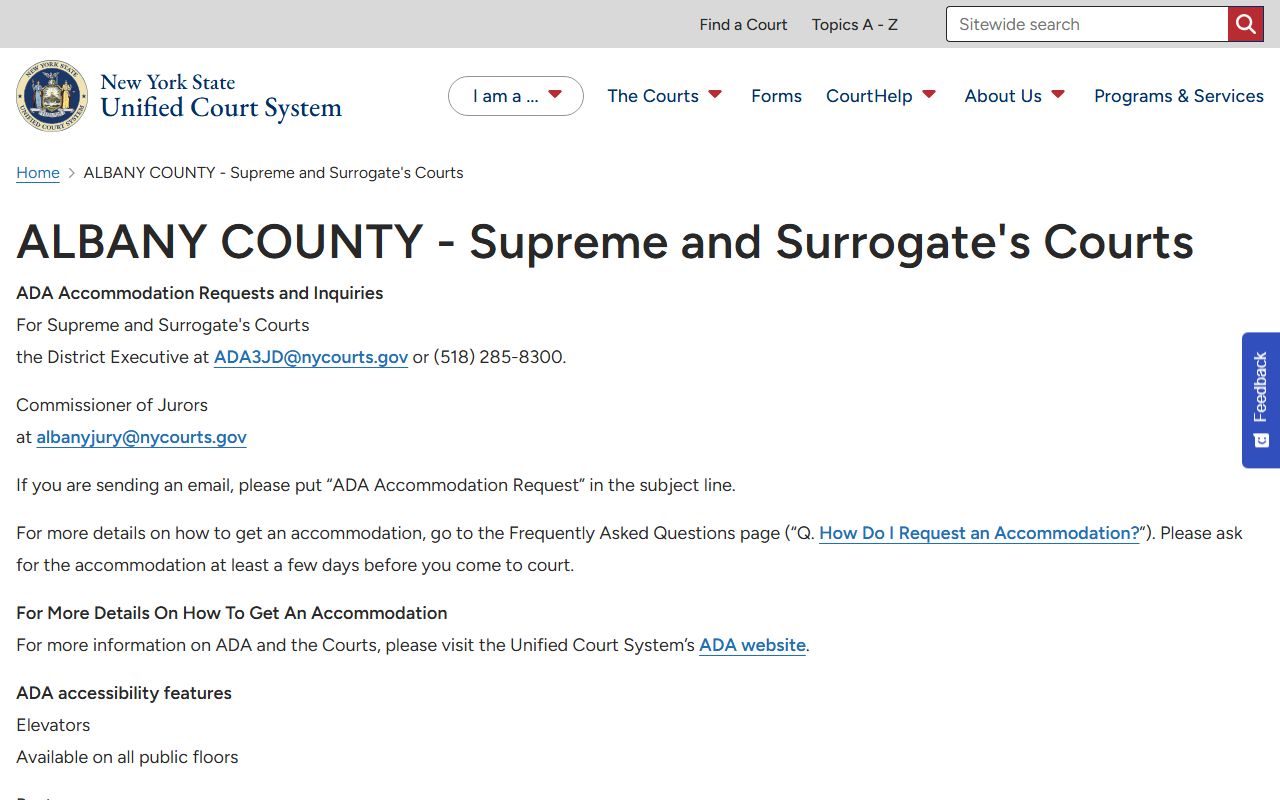
Use that landing page as a sanity check on courthouse hours and any temporary closures before a court visit.
Types of Court Records Available in Albany County
Records fall into a few buckets. Each bucket has its own custodian. Sending the wrong request to the wrong office is the most common mistake people make.
The records a court keeps depend on the cases it hears. A Family Court file looks very different from a Supreme Court foreclosure file. A Surrogate's Court estate file looks different from both.
- Civil court records: pleadings, motions, orders, and judgments from Supreme Court civil cases.
- Criminal court records: indictments, plea minutes, sentencing minutes, and dispositions from County Court and City Court.
- Family records: custody, visitation, support, family-offense, and juvenile matters with strict access limits.
- Probate records: wills, administration petitions, citations, letters, and accountings from Surrogate's Court.
- Traffic records: citation files held by Albany City Court or town and village justice courts.
- County recorded records: deeds, mortgages, liens, DBAs, and judgments at the Albany County Clerk.
What Albany County Court Records Show
A court record is more than a single page. It is a docket plus a stack of filed documents. The portal shows the docket. The documents may or may not be online. Some are sealed. Some are restricted to parties and counsel. The fields below show up on most public Albany County dockets.
| Field | What It Shows |
|---|---|
| Index or Docket Number | The court's case identifier. Supreme Court civil uses an index number; criminal cases use docket or indictment numbers. |
| Filing Date | Date the case opened. Useful for narrowing a name search. |
| Parties | Plaintiff and defendant, or People v. defendant, or Matter of (name), or Estate of (name). |
| Case Type | Tort, contract, matrimonial, foreclosure, felony, misdemeanor, estate, support, custody. |
| Disposition | Final outcome where shown. Judgment, dismissal, plea, sentence, decree. |
| Judge / Part | The assigned justice and part. Helps locate the courtroom on hearing day. |
| Next Appearance | Date and time of the next scheduled court event. |
Public Access Laws for Albany County Court Records
Two legal frameworks cover access in Albany County. The first is FOIL, which is New York's Freedom of Information Law. FOIL covers agency records, not most court files. The second is the body of statutes and rules that govern court records: Judiciary Law, the Criminal Procedure Law, the Family Court Act, and Domestic Relations Law. The agency a sheriff incident report goes through is different from the office a court docket comes from.
Knowing which path to use saves time. A FOIL request sent to the county for a Supreme Court divorce file will be returned. A clerk request for a sheriff's daily blotter may also miss.
Key Statutes:
Public Officers Law Article 6: New York's Freedom of Information Law. Starts from a presumption of access for state and local agency records.
Public Officers Law § 87: Lists FOIL exemptions for privacy, law-enforcement interference, trade secrets, and safety risks.
Judiciary Law § 255: Court clerks must search files and furnish certified copies for set fees. This is why certified court copies come from the clerk, not from FOIL.
Criminal Procedure Law § 160.50: Seals records after a criminal case ends in favor of the accused.
Domestic Relations Law § 235: Restricts public inspection of divorce and other matrimonial records.
Records That Are Restricted or Confidential
New York seals more than it expunges. Several categories of Albany County court records are not available through a public portal. A blank search result does not always mean the case does not exist. It can mean the case is sealed, sealed-by-statute, or routed through a court with limited public access.
Family Court files are restricted under Family Court Act § 166. Youthful offender records are confidential under CPL § 720.35. Juvenile delinquency records may be sealed under Family Court Act § 375.1. Adoption files are sealed by Domestic Relations Law § 114. Mental hygiene clinical records are protected by Mental Hygiene Law § 33.13. A party who wants to view a sealed record usually has to file a motion in the issuing court.
Specialty Courts in Albany County
The Third Judicial District operates problem-solving courts that handle treatment, mental-health, veterans, and integrated domestic-violence calendars. The district page at ww2.nycourts.gov/courts/3jd/problem_solving is the entry point. Eligibility is set case by case. The prosecutor, defense counsel, and judge all have a say in who enters.
Treatment courts use frequent court appearances, drug testing, and treatment compliance as a path away from a traditional felony sentence. Veterans treatment courts connect eligible defendants with VA, peer mentor, and housing resources. Mental-health calendars handle defendants whose behavioral-health needs drive the court contact. Integrated domestic-violence courts coordinate criminal, family, and matrimonial issues for a single family in one part. Records from these courts may show appearance history but rarely show clinical detail.
Albany County Sheriff and Jail
The Albany County Sheriff's Office runs the county's main correctional facility. The corrections page describes visitation, mail, phone, and bail rules. The county did not publish a fully open jail roster in the official sources reviewed, so custody confirmation often runs through a phone call to the jail, a VINELink registration, or the case file in court.
Federal custody is separate. So is state prison custody. A person sentenced to state time is tracked by DOCCS. A person in federal custody is tracked by BOP. The Albany County inmate records page lays out each system. The warrant records page covers what to do if a person fears an active warrant. The released inmates page covers post-custody verification, parole, and reentry.
Marriage, Divorce, and Surrogate's Court
Marriage licenses come from the Albany County Clerk. Divorce is filed in Supreme Court, not Family Court, but matrimonial records are restricted by statute. Estate matters run through Surrogate's Court at 16 Eagle Street. Each step uses different forms. Each fee is set by a different office. Full coverage lives on the marriage and divorce records page and the Surrogate's Court page.
- Testator
- The person who made the will.
- Executor
- The person named in a will to handle the estate. Surrogate's Court issues letters testamentary.
- Administrator
- The person appointed to handle an estate when there is no valid will. Surrogate's Court issues letters of administration.
- Petitioner
- The party who files a petition in Family Court, Surrogate's Court, or a special proceeding.
- Decedent
- The person who died and whose estate is before the court.
Albany County Court Records Fees
Fees come from three sources. Court filing fees follow state court rules. Clerk copy and certification fees follow the Albany County Clerk fee schedule at albanycountyny.gov. NYSCEF transactions follow the e-filing fee table. Always confirm the current dollar figure on the official page before you mail payment.
| Item | Source |
|---|---|
| Plain copy of a court file page | Court clerk or County Clerk schedule |
| Certified copy of a court record | Court clerk under Judiciary Law § 255 |
| Recording a deed or mortgage | County Clerk fee schedule |
| Business certificate or DBA filing | County Clerk fee schedule |
| Supreme Court index number | State court fee statutes and NYSCEF |
| FOIL copy fees | Public Officers Law § 87 and agency rules |
How to Read Albany County Court Records
A docket entry uses short codes. "Summons filed." "Answer filed." "RJI filed." "Motion seq 001." "Order entered." Each line carries a date and a short description. Read them in order.
An arrest is not a conviction. A charge is not a finding of guilt. A plea may be to a different count than the original charge. Look for the disposition line and the sentence line at the end of the docket. For employment, immigration, or licensing use, ask the clerk for a certified disposition. A screenshot is not enough.
Sealed cases drop out of the public view. So do youthful offender outcomes. So do most Family Court records. If a docket shows a case but no documents, it may be because the case is e-filed in NYSCEF with restricted public access.
Accuracy and Record Limitations
Albany County's official sources cover most of what users need. They do not cover everything. The county does not publish a fully open jail roster. It does not publish a separate "recently released" list. There is no confirmed countywide active-warrant search. Older paper files may not appear online at all.
Portal data can also lag the courtroom. A sentence may be on the record at 11 a.m. but not show in the docket until the next business day. The right move, when stakes are high, is to call the clerk and confirm.
Albany County Court records search results should always be cross-checked against the issuing court's clerk before being used for a job application, an immigration filing, or a firearm question.
Note: Always confirm sensitive case details with the issuing court before relying on a portal screenshot for legal or work-related decisions.
History of Albany County Courts
Albany has been a legal hub since the Dutch built the first court here in the 1600s. As the state capital, it sits next to the Capitol, the Legislature, the Governor's offices, and the Court of Appeals. The Appellate Division, Third Department also sits in Albany. That mix is unusual. Most counties do not host a trial-court bench, a court of appeals, and a major state-government law practice in the same six-block radius.
Article 78 proceedings, which challenge state-agency action, are filed in Supreme Court. Many of those cases land in Albany because the agency being sued is headquartered here. That gives Albany County records a flavor that other county dockets lack.
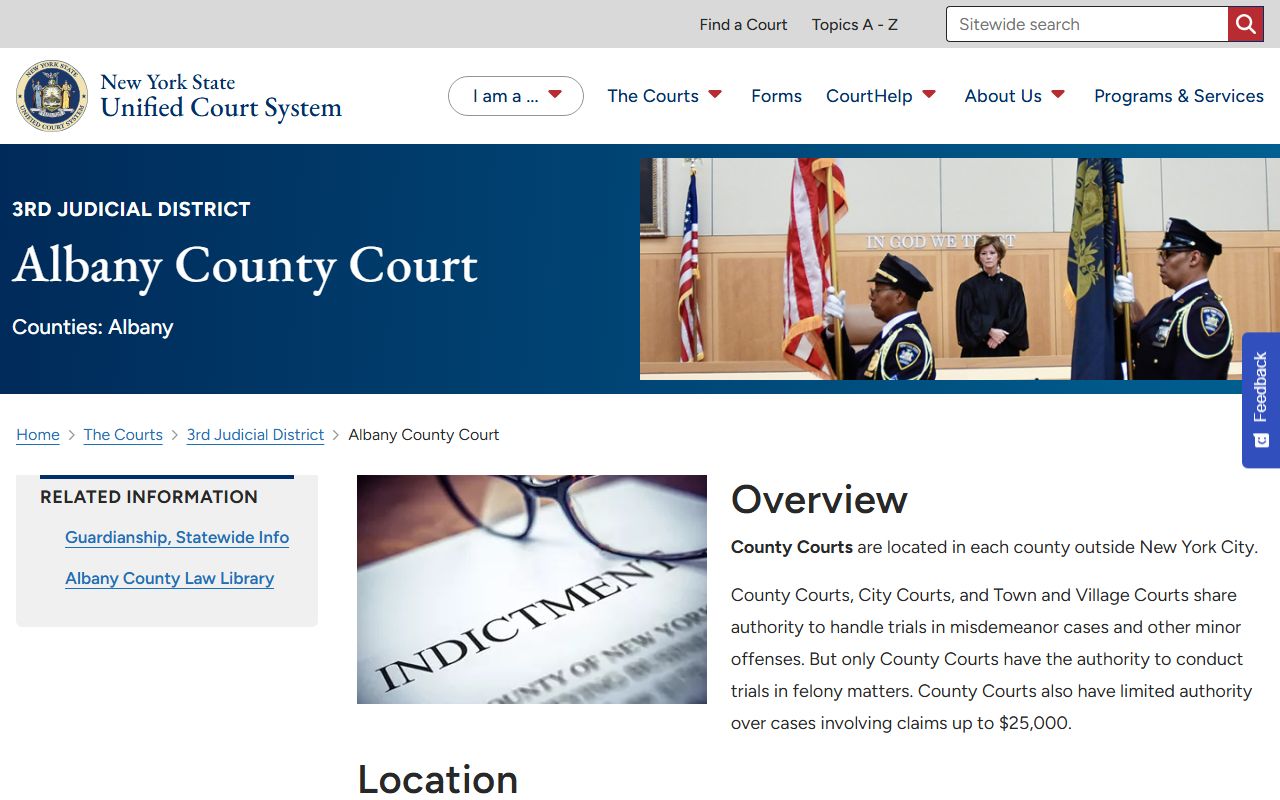
The County Court page lists current contact information for felony case clerks and matters routed to the County Court bench.
Getting to the Courthouse
Most court users arrive downtown by car or by bus. The Capital District Transportation Authority publishes bus routes and a trip planner at cdta.org. Downtown Albany has frequent service along State Street, Broadway, Eagle Street, and Clinton Avenue, so a bus trip to 16 Eagle Street is often quicker than parking.

Check the CDTA route number on the morning of your court date because schedules and stop locations change.
Frequently Asked Questions
Is there one Albany County court-record database?
No. New York splits records by court. The County Clerk, WebCivil Local, WebCrims, WebSurrogate, NYSCEF, Albany City Court, Family Court, and town and village courts can all be relevant depending on the case. A name search in only one portal can miss records held by another office.
Where do I look for a divorce record?
Divorce is a Supreme Court case in New York. But matrimonial records have special privacy under Domestic Relations Law § 235. A party can usually get a certified judgment of divorce through the court clerk. A third-party searcher cannot download the full divorce file from a public portal. Full guidance lives on the marriage and divorce records page.
Why can't I find a criminal case?
It may be sealed under CPL 160.50, treated as a youthful offender matter, filed in a court not covered by WebCrims, too new to appear, or filed under a different docket number. A no-result is not proof a case never existed. The Albany County arrest records page covers each scenario.
More Q&As live on the Albany County Court Records FAQ page.